
Professor Jay Lee: "ExaOne, a competitive AI, needs to build success stories in specific fields."
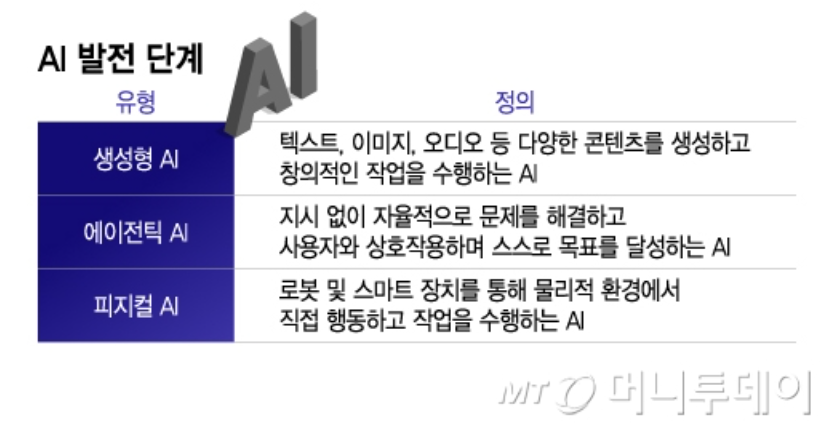
Since the 2022 release of the generative AI "Chat GPT," AI has rapidly entered our lives. Simply inputting a prompt (a message requesting or commanding a task) into a computer or smartphone allows AI to go beyond simple searches and provide answers through inference, even instantly producing high-quality images, videos, and music.
This AI is now expanding beyond computers and smartphones into the real world. Beyond text, images, videos, and music, it is beginning to integrate with and control real-world objects like cars and robots. While robots have worked in factories until now, they have limited themselves to repetitive, pre-programmed actions. In the future, factory robots will be able to independently assess their work environment and conditions. This will enable automation that goes beyond mere automation.
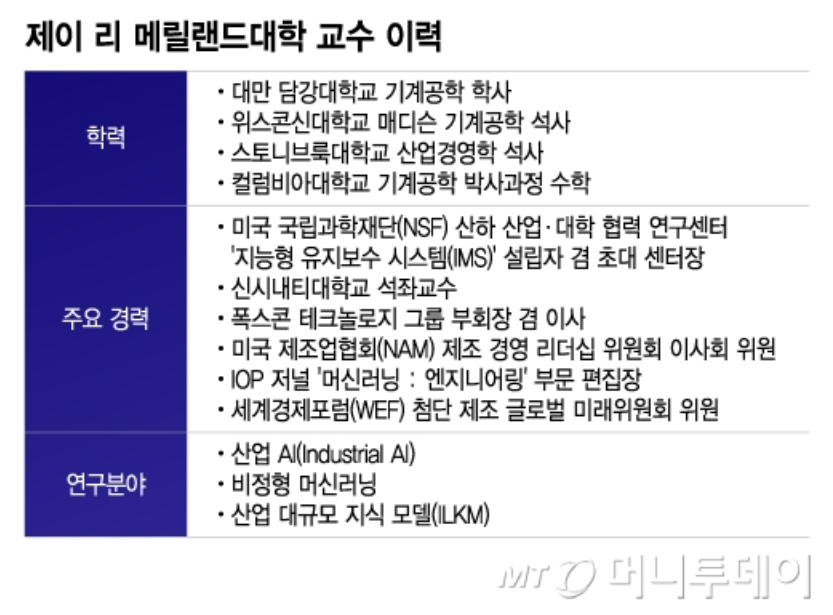
Given Korea's global competitiveness in manufacturing, it is considered a country with the potential to create greater value through AI. Jay Lee, a professor of mechanical engineering at the University of Maryland and a world-renowned expert in industrial AI , stated in an interview with Money Today, "Korea has a solid manufacturing foundation, so it has the opportunity to lead AI- driven manufacturing innovation." Professor Lee is considered a leading authority in the field of physical AI ( AI combined with physical environments such as mobility and robotics ).
The current AI craze is overblown… It needs to demonstrate economic value.
Professor Lee first pointed out that the current AI craze is excessive. Many people assume AI is omnipotent, without considering how to actually utilize it. He believes this is actually counterproductive to AI 's development.
"People are overly excited right now. They're only talking about optimistic ideas ( like AI can do everything). Some even say that a humanoid robot can imitate a person playing the piano. How can a robot play the piano just by watching? That may be a distant future, but it's completely unrealistic for now. Not everyone can play the piano. It takes learning and practice, not just watching. It's deeply concerning that even leaders, like CEOs, believe AI and robots can play the piano. They excel in their own fields, but they're talking too easily about areas they don't understand."
He emphasizes that we should focus more on how to create value using AI rather than focusing on AI itself . To achieve this , he explains, specialized AI that can achieve the goals of each industry and field is needed. "In addition to large-scale language models ( AI models trained to understand and generate large amounts of human language , hereinafter referred to as LLMs ), as we do now, we also need industry knowledge models. Within two years, the hype curve (a cycle curve showing the process by which new technologies develop in the market) and the economic value curve (a curve representing the utility obtained when consuming goods and services) should intersect. If economic value fails to increase, the hype curve will collapse very quickly. For example, if a company orders 400,000 GPUs (graphics processing units) , a key component of AI , and then suddenly reduces its demand to only 100,000 units, the market could plummet. It's similar to building a lot of houses, but then a low birth rate leads to a population decline, leaving an excess of houses. The same thing happened with Chinese real estate. No one believed it 10 years ago, but eventually, a bubble appeared."
" In the AI era, complete remote work is possible… We must learn new manufacturing processes."
Professor Lee predicted that the full-scale adoption of AI in industry will significantly change the way we work. He also anticipates that many new jobs will be created due to AI . He argues that adapting to these changes requires national-level education.
"Looking at the Air Force, we've traditionally recruited physically fit individuals to serve as pilots, but in the future, younger generations who are good at gaming will be working in control centers. This is the future of work and industry. Future manufacturing will also increasingly involve working from home. Through complete remote management, it will be possible to operate US factories while working in Korea. Future manufacturing needs to be redefined as a completely new concept. It's no longer about ' capability ' in terms of talent and ability, but rather ' availability .' People need to learn new manufacturing processes. The government should establish AI productivity
Professor Lee believes that data is particularly important in AI . While countries and major companies are currently competing to build data centers, he argues that small, on-site data centers that can collect relevant data for each industry are more practical than large-scale data centers.
"I explained the basics of AI as ABC ( Algorithm , Big Data , Computing). However, most people only focus on C. But the important thing is B, that is, data. This refers to data from users, industries, products, vehicles, etc. In the future, it will be an era of models smaller than LLM . LLM is already sufficient. We need small specialized models . Most data centers are now for LLM training. Large data centers have no purpose. It's like widening the highway but having no cars. Therefore, in the future, 'domain-specific mini data centers' will become important, rather than data centers that depend on large clouds. For example, it is much more practical to create a small medical data center next to a hospital, or a small manufacturing data center next to a factory."
Korea must move beyond AI infrastructure to building an ecosystem.
South Korea aims to become one of the world's top three AI powerhouses , alongside the United States and China . Given its global competitiveness in semiconductors, mobile communications, information and communications, and automobiles, South Korea has the potential to secure a solid position in the AI ecosystem and global supply chain. Professor Lee stated, "Korea is overly focused on Stage 1, which centers on AI infrastructure (data centers, power, etc.). Stage 2 is edge AI ( AI implemented on devices ), and Stage 3 is industrial domains and ecosystems. We need to move beyond Stage 2 to Stage 3. Korea has a solid manufacturing foundation, so it has the opportunity to lead AI manufacturing innovation. Regarding the AI ecosystem, excessive investment in AI and data centers in the LLM field is currently risky. Ultimately, physical AI applications will be the winners. The most important thing is to demonstrate to customers a complete ecosystem, from chips, computing, communications, cloud computing, and a robust community." Professor Lee also praised South Korea's AI "ExaOne." ExaOne, an AI model developed by LG , has surpassed 8.3 million cumulative downloads for nine models. In Microsoft's "AI Diffusion Report" published last October, ExaOne 4.0 ranked third globally, following OpenAI's GPT-5 in the US and DeepSec 3.1 in China. " ExaOne is a highly competitive product with diverse application platforms, including cloud and edge computing, and has great potential for ecosystem development in Korea. However, it is not at an industry-leading level like the recent development of Google's Gemini 3.0. I think it would be better to first apply ExaOne to Korean businesses and specific field applications, build solid success stories and evidence, and then promote it to the global market. Actions speak louder than words about competitiveness."
Repost from here.